Discover how Intelekt AI detects and handles interruptions in real-time voice calls to deliver near-human CX in collections, support, and onboarding.

Parul Chouhan
Chief of Staff
When voicebots interrupt you the wrong way, it kills the conversational flow. When they handle it right, you don’t even notice it.
Interruption detection isn’t a “nice to have”—it’s mission-critical for voice AI systems. At Intelekt AI, we’ve crossed over 2 million minutes of production voicebot usage, and here’s what we’ve learned: properly managing when and how a bot interrupts is one of the biggest factors in making voice AI sound and most importantly conversation, human.
We walk you through:
How interruption detection actually works
Why most bots get it wrong
What Intelekt does differently
Real-world benchmarks
What enterprise buyers should look for
TL;DR: Smart interruption detection = better CX, fewer errors, more trust and better interactions.
What Is Interruption Detection?
Interruption detection is the bot’s ability to recognize when a user is speaking over it—and decide what to do next. Without proper interruption logic, bots feel either too aggressive or too slow—hurting CX.
A good system:
Stops speaking when the user interrupts
Doesn’t pause unnecessarily for noise or silence
Can resume or change track based on the new input
This is especially hard in telephony-grade environments with poor audio quality, background noise, and latency.
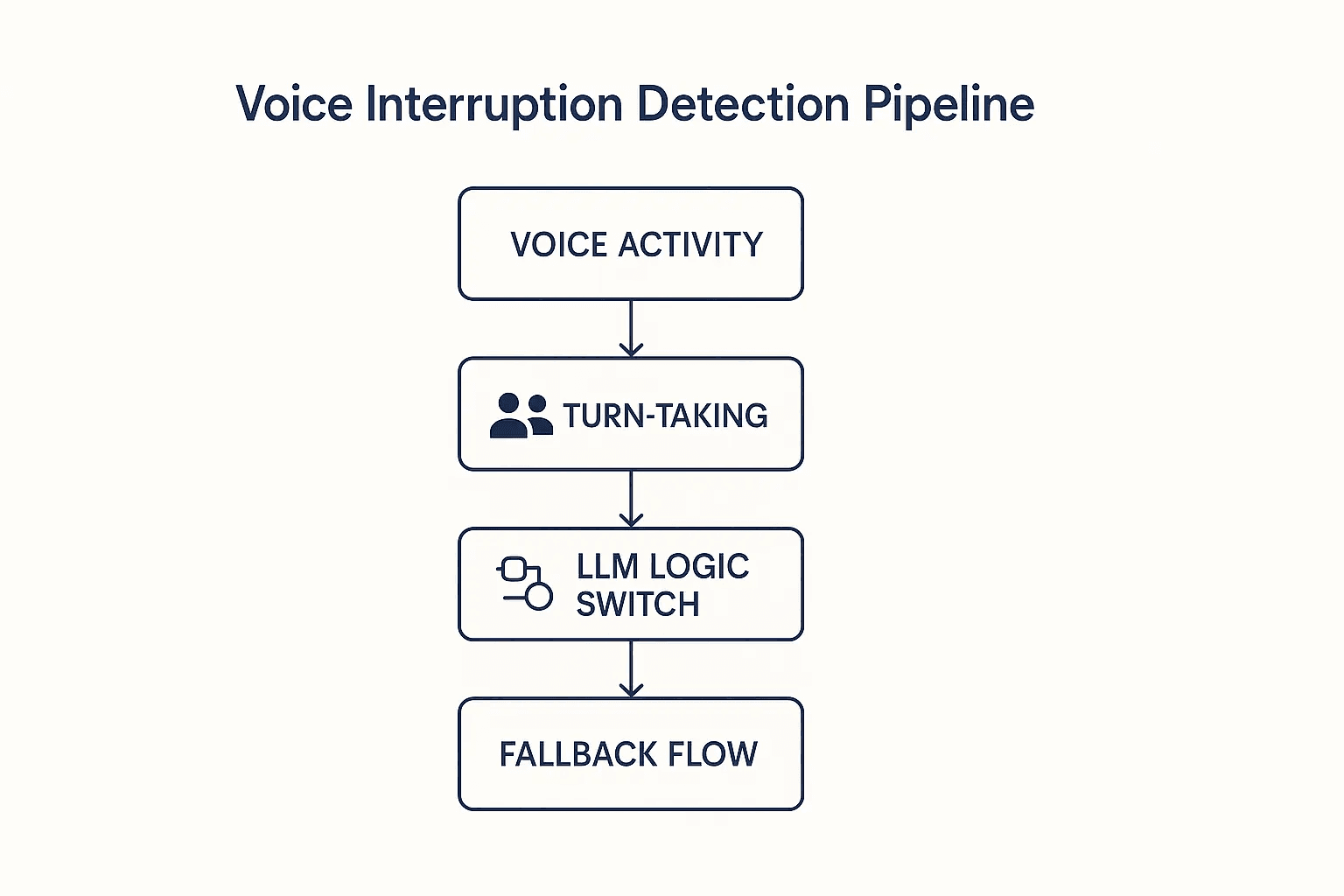
1. Voice Activity Detection (VAD) as the Base Layer
Everything starts with VAD—the engine that tells your bot, "someone’s speaking."
Most bots rely on default STT VAD, which fails in noisy real-world calls. At Intelekt, we use VAD models fine-tuned on Indian telecom conditions to:
Filter out ambient, say background noise
Avoid triggering false responses
Identify real speech vs dead air
2. True Turn-Taking Detection: Human-Like Pausing
Turn-taking isn’t just silence—it’s semantic intent. We go beyond pause thresholds and use context:
Common interruption phrases (“But wait…”, “Actually…”, “Hello, Hello”)
Behavioral triggers (raised tone, urgency)
Dynamic thresholds (<400ms in known back-and-forth flows)
This builds on TEN Turn Detection and our own tuning from 2M+ minutes.
3. LLM Logic for Context Switching Mid-Sentence
Some interruptions are benign and Voice Bots are trained for them accordingly. Others mean “STOP, change context now.”
We handle this using:
LLM-powered NLU triggers
Interruption handlers mapped to intents
Graceful fallback and resumption logic
Example: If user says “I already paid!” mid-script → Stop flow → Confirm payment → Route accordingly
4. Real-World Metrics: What We Track at Scale
Here’s what interruption detection performance looks like for Intelekt:
Metric | Target (Intelekt AI) |
|---|---|
VAD detection accuracy | 93% |
False interruption triggers | <5% |
Turn-taking latency impact | <50ms |
Mid-sentence switch handling | 88% success rate |
You can't improve what you don't measure. These metrics impact containment rate, NPS, and call durations.
5. Fallbacks, Logging, and Enterprise Ops Control
Even with great detection, things break. That’s why Intelekt offers:
No-code interruption phrase editor
Full QA logs with interruption timestamps
Ops dashboard for anomaly detection
Admin override tools for flow management
Key Takeaways for Buyers
Feature | What to Look For |
|---|---|
VAD | Telecom-optimized, low false triggers |
Turn-taking | Semantic + timing-based logic |
LLM/Intent Handling | Contextual pivots mid-flow |
Ops Visibility | Logs, metrics, controls |
Multilingual Performance | Regional nuance in interruption logic |
Don’t trust demo calls. Test with noisy, real-world data and live users.
Hear Intelekt AI in Action
Check out how Intelekt handles real interruptions. Listen here
Or experience it with your own flows: Click here
Checkout Our Buyer’s Checklist for Voice AI
Benchmark your current provider’s interruption detection logic with our enterprise checklist. Read here
Related Posts