Your essential 2025 enterprise voice AI buyer’s checklist—features, security, latency, LLMs, and more. Avoid hype traps. Choose a voicebot that performs.

Parul Chouhan
Chief of Staff
Voice AI is becoming an important day to day part of most enterprises for customer support and outreach—but how do you choose the right platform?
Too many enterprise buyers get bombarded by demos but get confused in deployment. This checklist is your 2025-proof guardrail to choose which Voice AI is the right fit for your enterprise.
Whether you’re building automated collections, refund flows, or customer support with voice AI, this comprehensive buyer’s guide ensures your team checks all the must-haves—before the contract is signed.
1. Voice AI Latency Must Be Under 500ms
If your voicebot takes more than half a second to respond, users assume it’s broken—or worse, a scam.
Why low latency In Voice AI matters: Low-latency voicebots mimic human conversation better. They drive higher containment, less dropout, and smoother handoffs.
Slow response = 38% higher call abandonment.
2. Your Voice AI Should Support True Context Switching
Real conversations aren’t linear. A good voice AI should handle interruptions, change of topic, and return smoothly.
What if a user starts with a refund request but changes mid-way to product complaint. Does the bot keep up?
If it says, “Sorry, I didn’t get that”—you’ve lost them.
3. Choose Voice AI with Native Multilingual Capabilities
Don’t settle for translated scripts. True enterprise-grade voice AI should support multilingual conversations, trained on regional accents and idioms.
Hear it in action: Intelekt’s Hinglish Voice AI Samples
Why this matters: 70% of Indian voice users interact in regional languages.
4. Ensure Seamless Handoff to Human Agents
No matter how smart the bot, fallback is crucial. Ensure that your system can:
Detect escalation intent
Transfer context + history to the human
Do this without repeating info
While analysing your Voice AI partner, ask for a live demo of the fallback sequence.
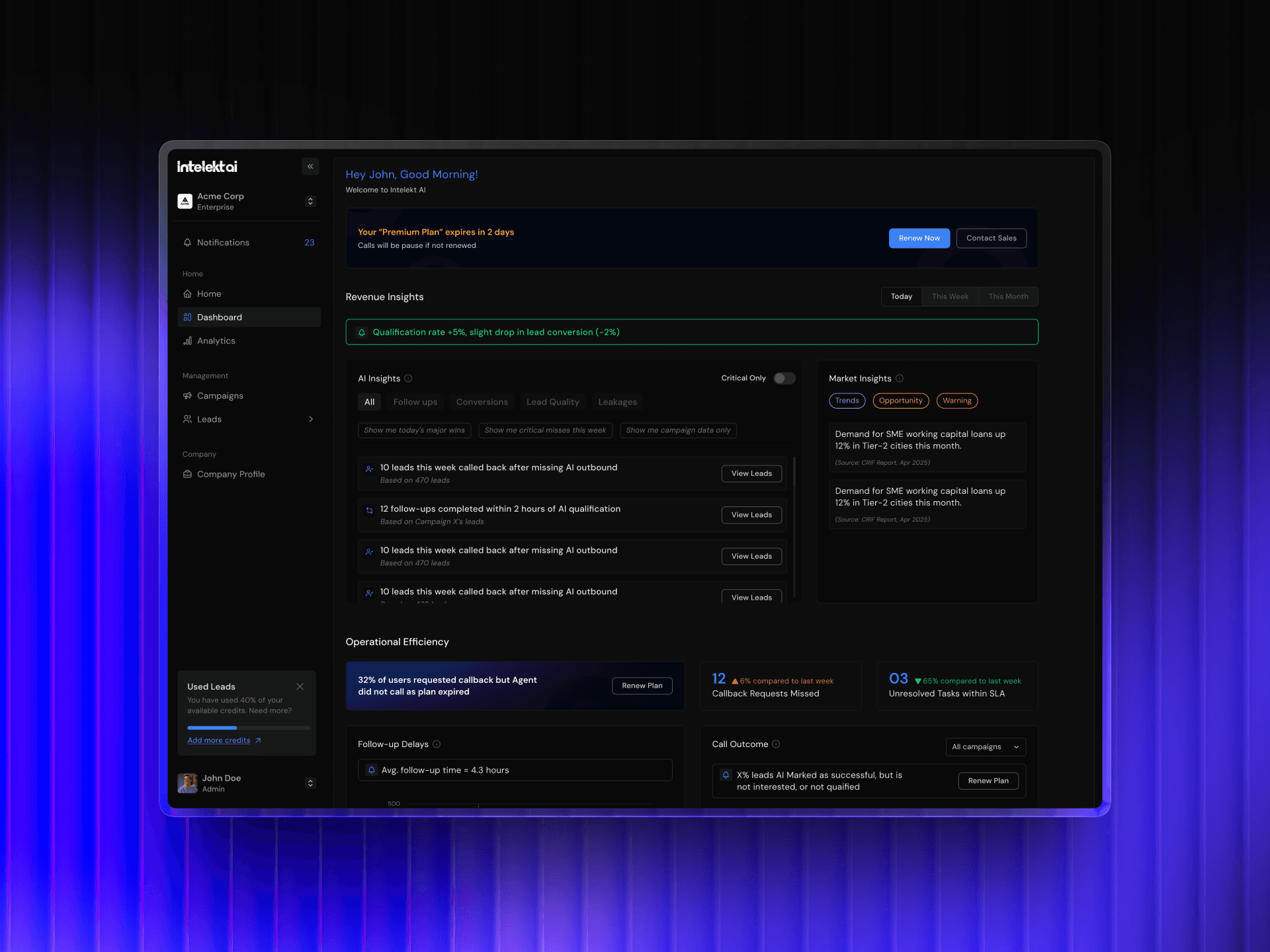
5. Look for Real-Time Voicebot Transcripts and Monitoring Tools
Want to monitor calls? Need compliance or audit trails? Your vendor should offer:
Live call transcripts
Agent whispering / monitoring tools
Downloadable call logs
Why it matters: Regulatory hygiene + internal coaching.
6. Voice AI Must Include LLM & Intent Engine Capabilities
A 2025-ready voice AI doesn’t just follow scripts. It adapts. Look for:
On-call learning from real interactions
Custom LLM finetuning
Behavioral intent detection
As a leading enterprise, Ask if they support custom domain-specific models.
7. Pick a Voicebot Platform with No-Code Conversation Designer
Don’t depend on engineers to change a greeting.
Drag-and-drop workflows
Easy versioning + rollback
Preview + test sandbox
Check if your marketing or ops teams an update flows without tech?
8. Voice AI Must Offer Enterprise-Grade Security & Local Hosting
Make sure they offer:
ISO 27001, SOC 2 compliance
Indian data residency (if needed)
9. Evaluate Integration with CRMs and Telephony Stack
Your voicebot isn’t useful if it’s not connected. Ask:
Can it integrate with your CRM (Salesforce, Zoho, Freshdesk)?
Does it plug into your existing dialers (Exotel, Ozonetel, Twilio)?
What does the API documentation look like?
Voice AI should enrich—not replace—your existing workflows.
10. Ask for Proven ROI Benchmarks
If they can’t share real metrics, walk away. Ask for:
Containment % in real clients
Call deflection numbers
Resolution rates and CSAT impact
Intelekt AI can perform 78% call containment in BFSI collections
Voice AI should be a revenue + CX tool. You deserve proof.
Book an Intelekt Voice AI Demo Built for Enterprise Ops
Ready to see these features in action?
Book a custom demo with Intelekt’s voice AI platform for BFSI, fintech, and enterprise customer service use cases.
Related Posts